Monday, February 18, 2019

Review 11: Solaris

Solaris Solaris by Stanisław Lem
My rating: 4 of 5 stars

After trying to watch the movie version (multiple times) of this book and falling asleep every time (maybe both versions) somehow I still was attracted to this story. I didn't expect much given my boredom with the story before. Yet I was riveted to this. I raced through much of the book. Was it due to the narration done by Alessandro Juliani, or the story? I think it was both.

The idea of the others, the visitors and the creepiness was unexpected. One of the main things I remember from the more recent film version was the light. The book mentions the colors of the suns and the light and darkness more than you find in other books. This visual experience almost takes on an aspect of character as well.

Despite my intense fascination with the story when it ended I felt let down. It didn't feel resolved. No, it didn't need to be fully resolved, but I did want a little more with the ending. Perhaps a glimpse that there was some concrete headway into solving the Solaris question these scientists were studying.

I have this feeling a second reading would get more out of the book. Not sure that will happen, at least not sometime soon.

Saturday, February 16, 2019

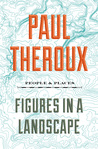
Reissue Review 10: Figures in a Landscape: People and Places

Figures in a Landscape: People and Places Figures in a Landscape: People and Places by Paul Theroux
My rating: 4 of 5 stars

Reissue Review #1: On occasion revisiting and reissuing reviews from the days before my blog postings. 

A recent read: finished on December 24, 2018.

Paul Theroux has written many books, he's been around a while and traveled far. Somehow, even though I own one or two of his books, this is the first book I've read by Theroux. It's a collection of essays that has no overall theme, essays collected that he wrote through the years 2001-2016. All of the essays were previously published, either in magazines, or as introductions to books, and many appeared with different titles.

I do wish it was listed when the essays were written or published previously. This particularly struck me with several essays that dealt with celebrities he interviewed; Robin Williams, Elizabeth Taylor, Michael Jackson and Oliver Sacks, (okay maybe Sacks isn't a celebrity per se, but he is a famous neuroscientist), all of whom have already passed away by the time of the publication of this book.

With a few exceptions, I felt the essays got better the more I read the book. I think the middle and later essays were more engaging, less flexing of the vocabulary, stretching out to find those obscure and infrequently used words. Keep a dictionary nearby! One essay about a third the way though, "Nurse Wolf, the Hurter" was overly long and very unappealing. It just went on and on, and nearly had me quit reading the rest of the essays and the book. Happily it was the worst of the bunch and I carried on.

I think the essays collected here may have worked better as an overall book if there had been an overall theme, or sections at least, with a theme or grouping. Most essays were about other authors or celebrities, not nearly all. There also was a little repetition of some information as an idea or something in one essay appeared in another. This was particularly true near the end of the book with one essay, "Dead Old Dad: Memories of My Father" and the very next one "The Trouble with Autobiography" repeating some similar statements about his past. The last essay, his non autobiography is funny as it provides less information about himself as the previous essay.

Perhaps this book wasn't meant to be read cover to cover like most books, but to pick and choose which essay looks appealing and in whatever random order. It is a long 386 pages with the small print. I'm sure fans of Paul Theroux would enjoy the book, and for those who are new to his work as well.


I should also give thanks to Houghton Mifflin Harcourt and NetGalley for allowing me access to an advance electronic copy of the book. Although, I did read the print book my library purchased, I do appreciate the early review access.

Thursday, February 7, 2019

Review 9: Sugar Run

Sugar Run Sugar Run by Mesha Maren
My rating: 2 of 5 stars

This book was a disappointment. It was also a tad boring, surprising since the premise doesn't sound like that at all. The book starts with Jodi just being released out of jail after 18 years, early even, after killing her girlfriend Paula. The book slowly tells you the story of what led up to the shooting, was it an accident, or purposeful? The main part of the book is after she leaves jail. First she wants to Paula's brother, to save him, as they had always planned. Along the way she picks up a new girlfriend, Miranda, plus her three kids. With all five stuffed in Miranda's car they go back to her grandmother's land in West Virginia Appalachian mountains, to start a new life.

It sounds interesting, but it wasn't. It fell flat. Whenever there was a little action, it kept being interrupted by another chapter break. We'd switch to the current or past, when it went back to the action well now that was moved past it. There was so much focus on driving, pills and drinking, oh and smoking cigarettes, maybe this is what the book is about. I wanted more about the land, the connection to it, and the fracking or other mining taking it away. Some of that was here, but again, it was subdued.

I almost stopped reading several times, and perhaps should have, but I'm curious and would wonder if it got any better. Not really. Not all books are wonderful and the duds make better books stand out even more. Go ahead and skip this one.

Book rating: 2 stars


I received a free copy of this book at a library conference. I was not required to write a review, but felt like it and, of course, the above opinions are my own.

Monday, February 4, 2019

Review 8: The End of Nature

The End of Nature The End of Nature by Bill McKibben
My rating: 5 of 5 stars

Last week I read my first book by McKibben, Radio Free Vermont: A Fable of Resistance and it was his only fictional one. I knew it wasn't the best place to start with his work, but it was short and after just reading some longer books, I wanted a quick read. The subtitle of that book made it more intriguing so I did start there. It wasn't an overwhelmingly environmental novel as it was more overwhelmingly local. Oh, but yes, local is part of being more "green".

Anyway, since I'm planning on attending an event soon where Bill McKibben is speaking, I thought it best to finally read something by him that represented his work. Now this book here, The End of Nature, is probably his most iconic book. I have known about this book, and others he wrote, but held back reading any of them, even held back buying any of his books. It feels a little odd to me since really I have a shelf or two of just these types of books, environmental in nature. And perhaps that is the exact reason why I haven't read McKibben before, I have these other books, read some of them, and overall thought I knew what he was writing about, what he said in his books. It's a bit silly of me I know, but I'm being truthful here. I figured I didn't need to read another writer about the same topic.

Yet, I decided before hearing him speak I should try his work. Quickly after starting this book I realized the mistake I made long ago, and kept making year after year. I should have read this book sooner. Perhaps read more of his books. Not so much that it taught me something I didn't know before, but that it was a good book. It was more engrossing and thought-provoking than I expected. I grew to ponder his sentences as well. Now why would you say like a half glass of gin and tonic, instead of a half glass of water? Probably because you would expect the word water, and not gin and tonic. That makes the writing more readable, more interesting.

This book has put together a lot of specific details and facts and made them readable. McKibben has added his own personal life in here to make it more relatable. What is most significant perhaps is his main thesis how "we" (meaning us humans, but mostly in the West) have now ended the natural, or wild nature. We have affected the change in all animals and plants with our consumption and procreation. There are no longer any place in this earth that is not pristine or untouched by what we have done. And still we do crave the wild, don't we?

And how much nature is completely destroyed depends on how much we are willing to let global-warming go. From here on out nature is being managed, much like a park is not a natural green space but a planned area designed for humans, not the plants or any animals that may inhabit the park .

It is not a happy book, but I'm glad I finally read it. I have many questions for McKibben now, as this book was written two decades ago. Perhaps some of those questions have been answered in his more recent work. At some point I shall find out.


Note on Audio book narration: This book was narrated by Jeff Woodman. I hadn't heard any of his narrations before, but this was an excellent work. His emphasis on the right words enhanced the reading of the book. I had a print copy of the book and read passages, some already listened to, some going forward, but I relied on the audio narration. I doubt I could have read the book as well, and as quickly if I read only the print copy.

Narration rating: 5 stars


Previously Read Bill McKibben books:

Bill McKibben books read later:


Previous Popular Posts