Showing posts with label Japan. Show all posts

Tuesday, September 15, 2026

Review 738: How Can My Manager Be So Stupid?

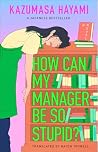
How Can My Manager Be So Stupid?How Can My Manager Be So Stupid? by Kazumasa Hayami
My rating: 3.25 of 5 stars


Another fictional workplace book, this one about being a bookseller. Admittedly I was pulled in by the cover artwork.

The main character, Kyoko Tanihara works at Musashino Bookshop. She is frustrated with her job, the manager especially. She works in the literature department and is frustrated that publishers don’t send the books that she knows would sell. She orders the books, but they don’t arrive, or if they do only one or two copies, when they could sell many more. There are customers who complain that they want the hottest new book, but the store can’t get it. Although it’s the manager who Tanihara mainly complains about and how he runs things. His morning meetings he usually is glowing about a management book that everyone should read.

Through most of the book Tanihara is on the verge of quitting. She does have a lot of anger, but she is a book lover and is very involved in the dynamics of the job and even with an author or two. I was lukewarm through most of the book, but I liked how it ended up.


Thanks to Penguin Group Putnam/G.P. Putnam's Sons and NetGalley for an uncorrected electronic advance review copy of this book. However, I listened to a published audiobook copy of the book.

Friday, May 23, 2025

Review 585: Go

Go Go by Kazuki Kaneshiro
My rating: 3.5 of 5 stars


This was not an enjoyable book for me. I disliked the main character, Sugihara through much of the book. But I kept reading as I haven’t read many Japanese books, and none where the main character is considered Korean. It’s a different life to explore.

Why I didn’t like Sugihara is mainly due to all the fighting. I’m much more for peace than fistfights. And fighting scenes are not what I want to read. When the book shifted to the girl Sugihara dates it became more pleasant for me, less fighting. But the ending, I did not like.

The book highlights prejudice and assumptions. Sugihara was born and raised in Japan. His father, however, was born in Korea. He left and settled in Japan. Both of Sugihara’s parents retain North Korean passports. There was a choice but his father was somewhat idealistic and chose the north, so his son was raised in the North Korean schools.

When Sugihara was about to enter high school his father wanted to visit Hawaii, which was impossible to do with a North Korean passport so he just switched to South Korean and was able to visit. This was a revelation for Sugihara, as he realized you can just switch your nationality and it means nothing. You are who you are regardless of which passport you hold.

What Sugihara has difficulty in accepting is the harassments for Korean people in Japan. How is he different than a Japanese as he was born and raised there? Why does Japan treat him like a foreigner? Interesting questions.

Since this book became a success in Japan when it came out over 20 years ago, one may hope there has been some changes. Although racism is hard to overcome in any country. Glad I read this despite my somewhat lack of enjoyment, still got something out of the book.

Monday, February 3, 2025

Review 546: A Gesture Life

A Gesture Life A Gesture Life by Chang-rae Lee
My rating: 4 of 5 stars


Franklin Hota known as Doc Hota around the quaint town of Bedley Run is our main character. This novel is mainly a character study. A Korean-Japanese immigrant to the United States, now living in a small town in New York. He sets up a shop of selling medical supplies, which is how he became known as Doc. He always tells people he’s not a doctor, but they insist on the moniker.
He adopted a daughter, Sunny, and named his business after her, but the relationship had never been a good one. As the book continues Franklin reveals more of his life during the war, where he served as a medic in the Japanese forces. His unit didn’t see much action, but they did have comfort women.

The book is not fast paced. There are a few people he becomes friends in town, particularly a neighbor he had a relationship with for a few years, but overall he seems to be a lonely person. Some of this stems from his childhood, where his parents sent him to live with an adopted family to become Japanese.

I never got a clear view of his relationship to his daughter while she was growing up. There were few snippets of that time, and she seemed to be removed emotionally from him. But without more to go on, it was hard to get a good sense.

There is movement of the daily life and things that happen, but overall no real plot. The story is propelled by the revelations of his time during the war and what actually happened.

The language and writing style was well done. I had this book sitting on my bookshelves for well over twenty years, not sure why I waited so long.


I started reading my print book. Around 40% through the book I wanted to read it faster, and sometimes I have more time to read via audio. I found the audiobook at my local library and finished the last 60% in a two days, where the first part took about a week. 

Friday, July 19, 2024

Review 498: Kokoro

Kokoro Kokoro by Natsume Sōseki
My rating: 4 of 5 stars


This is a classic Japanese work of literature, published in 1914. The first part is about the narrator meeting and befriending a man who he calls Sensei. The narrator is a student at a university in Tokyo. Sensei becomes someone he is fascinated by, who was reluctant to open up to friendship. Slowly they do become friends and when prodded Sensei will not discuss his past. Sensei doesn’t work, has a wife and maid, and visits the gravesite of a friend every month. He is an intellectual and the two often discuss philosophical idea.

The second part is concerned with the narrator’s family. His father is ill and he has gone back home in the country several times to visit with his father. The summer months he also goes home to stay and visit. After graduation he returns to his home and this part is very concerned with his father’s health, particularly after the Emperor falls ill and dies. During these days the narrator gets a letter from Sensei.

This letter takes up the last portion of the book. It is a recounting of Sensei’s past. It has to be one of the longest letters in a book ever.

This is not a book of action, rather one of contemplation and character study. One can take moral reasoning from this book as well, but that is not fully understood until the last.

While listening to this book as an audiobook I thought it was all one narrative. Upon finishing I read more about the book and found that it is described as three short stories. Perhaps, but it is about the same characters and the time line progresses through these three stories. It is more like three parts within a larger work, although conserving each as a short story does help to explain the seemingly abrupt endings.

Previous Popular Posts