Showing posts with label California. Show all posts

Monday, July 6, 2026

Review 712: The Ephemera Collector

The Ephemera Collector The Ephemera Collector by Stacy Nathaniel Jackson
My rating: 3 of 5 stars


This was an unusual and unexpected book format, reminded me of a post-modern style book, but it wasn’t that. It is not a straightforward book by any means.

There are pages of images, some that repeat are a timeline that I found helpful to understanding the full story. There are other images, maybe some from a dream journal. There are poems and excerpts, from a journal maybe. It’s not very clear where these textual parts.

There are two stories here. The main frame of the book is with Xandria Anastasia Brown, who is an archivist at Huntington Library, Art Museum, and Botanical Gardens. In 2035 she's been having health issues, particularly memory lapses, and passing out, when an event happens at the library. It has to do with BlackoutWika, which she established but wasn’t involved in this event. She became locked in her office, which happily contains essentials for surviving for a few days. Xandria doesn’t understand what is going on. Yet she still strives to continue working with the archives, she is focused on the work.

The very opening of the book has Xandria talking in an interview on her 300th birthday. Something happened to her medically that caused her to stop aging.

The second story takes place further in the future, at Diwata, an underwater community that was built to escape the devastation on the surface. While other communities went into outer space, this group, the Black Reconstruction Collective, established themselves off the coast of California.

There is an audiobook for this but I’m not sure if that would translate well as there is much here that is visual, not just what was mentioned above, but also with the formatting. There are bots that communicate which is identified by brackets, maybe audio can adapt that part. Anyway, not sure this is one to attempt in audio.

Overall, there were parts of this book I liked, some I did not. There was some repetition, which I didn’t like, and some parts of the book were confusing. I found the bot named sassafras interesting.


Friday, March 20, 2026

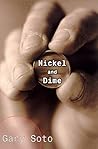
Review 676: Nickel and Dime

Nickel and Dime Nickel and Dime by Gary Soto
My rating: 3 of 5 stars


This somewhat short book contains three related stories. They take place in Oakland, California in the 1990s.

The first story: We Ain't Asking Much the main character is Roberto Silva, happy to have been let go at Walnut Bank as a security guard. His job was replaced by a security camera. Soon enough though, Roberto finds himself out of money and homeless, trying to sell something in order to eat.

The second story called Literary Life has Silver Mendez as the main character. A poet past his prime and happy to have this reading a small college in central California. Once home he finds his stuff on the lawn and kicked out of his apartment. Mendez at least has a car for shelter and ends up befriending Roberto who’s been homeless for two years now.

In the last story called The Untimely Passing of the Clock Radio we return to Walnut Bank as the other security guard, Gustavo Hernandez, is about to retire. Despite working for the bank for years he doesn’t have much savings. Roberto appears in this story as well, five years after his parting with the bank, and now asking Gus for help.

These are not joyful stories, looking at Hispanic men as they become homeless, or very poor despite loyally working for a company for years. What I didn’t like his how the three men are portrayed as simple, not very intelligent. And yet, there is a wee bit of humor laced into these stories as well.

Thursday, July 24, 2025

Review 603: The High Desert

The High Desert The High Desert by James Spooner
My rating: 5 of 5 stars


When I saw this book at my library I had to read it. I was not a punk, but did listen to some of the music and saw some punk bands play a few times. Also in the 90’s, the era of the book, I spent some time in Apple Valley where this book takes place. I did not go to the high school there, nor knew anyone who actually lived in Apple Valley. But I did have a friend who had a house that he rented out, when empty a group of us would go up for a weekend sometimes. So this book has some familiarity.

Through the whole time reading the book I felt for James Spooner. He had it tough and as a teenager there’s already a lot going on. Moving as often as he did wasn’t helpful for finding long-term friends. On top of it the horrendous racism he encountered, he was a mixed-race kid. Spooner found himself identifying with the punk music and fashion, the way it presented itself, and in this crucial year he was learning.

Over the Christmas break he spent it at his dad’s in New York City. There he ran into a few punks that helped educate him which was pivotal in his life. The more Spooner learned about punk, the more it resonated with him. Back in Apple Valley still feeling lonely, never getting the girl. The attempt at being in a band didn’t work out, his friends were also going through some rough times. It didn’t help that they hung out with racist skinheads.

I was happy to see that SHARP (Skin Heads Against Racial Prejudice) was mentioned, and the history of how skinhead culture got coopted by racists.

This was a personal memoir but it also speaks to being other.

Thursday, May 22, 2025

Review 584: Lost at Sea

Lost at Sea: Poverty and Paradise Collide at the Edge of America Lost at Sea: Poverty and Paradise Collide at the Edge of America by Joe Kloc
My rating: 3.75 of 5 stars

Just north of San Francisco in Marin County is Richardson Bay and the city of Sausalito. This location is where the book takes place, with stories and life experiences by a community of people called anchor-outs.

They live in the bay on boats not sanctioned by any government agency so the city and harbor master take to removing the boats. When someone isn’t living in one every day, the boat is impounded then destroyed. Although some called the people unhoused before they lost their boat, now they really are homeless.

This is a collection of stories but lacks solutions or other commentary than just stating what this community has experienced over the past ten years or so.

People have been living in boats for a long time, over a hundred years, since the time of the great earthquake in San Francisco in 1906. Some of the current community members have been living on their boats for decades. This is not a new community. Except the number of boats expanded by nearly doubled when the financial crisis hit.

Marin County is a wealthy community and some residents complained about their view. There were complaints about the anchor-outs polluting the waters, although no ecological testing proved this was an issue.

The author spent nearly ten years visiting these people, hearing their stories and at times living with them. When nearly all of the boats had been impounded and torn up a tent city erupted. Kloc slept in the tents for a few days as well, this being around the time of the pandemic.

Kloc and some of the anchor-outs attend city council meetings. It becomes very eye-opening when you realize a city, or other government agency is willing to spend thousands of dollars, in this case close to half a million dollars, on legal fees to evict and otherwise harass these unhoused individuals. None of this money is spent on providing any relief for these people.

Something missing from this book is more information on the house boats that are legally in the bay. They are mentioned very briefly but not deeply enough to provide context. How is it that there is a community of people living on boats in the bay accepted and others are not. It may just boil down to money, as usual, but this part of the story is lacking.

Unfortunately, there isn’t much of a conclusion to the book either. No solutions or options were provided, it really is just a collection of stories about some of the people’s lives who lived in the bay in unusual living conditions.


Thanks to Dey Street Books and NetGalley for an uncorrected electronic advance review copy of this book. However, I listened to a published audiobook copy of the book.


Monday, May 12, 2025

Review 580: A California Bestiary

A California Bestiary A California Bestiary by Rebecca Solnit
My rating: 5 of 5 stars


A very small book showcasing 12 animals in California. A couple are now extinct, or nearly, while others have been close to extinction, yet rebounded successfully, such as the elephant seal. Then there are a few that are abundant.

Each animal is accompanied by a color image drawn by Mona Caron. The essays are short and informative. My only problem with the book is that it was entirely too short.

Tuesday, November 19, 2024

Review 530: Defending Giants

Defending Giants: The Redwood Wars and the Transformation of American Environmental Politics Defending Giants: The Redwood Wars and the Transformation of American Environmental Politics by Darren Frederick Speece
My rating: 4.25 of 5 stars


This is an in-depth look at the fight to save old growth redwoods on the California northern coast that are now known as the Redwood Wars. The redwood tree is known by several names, scientifically as Sequoia sempervirens, colloquially as coastal redwoods, California redwoods, or just plain redwoods. Their preferred habitat today is along the coast of Northern California reaching into Oregon. The old-growth trees that were at the heart of the redwood wars are forests and these giant trees which can live for two-thousand years.

With the narrow range of where these trees can grow, which like coastal fog, the 1.3 million acres of area from pre-Columbus days are now down to just 5% of the land. And to save that five percent was a hard fought battle that this book describes.

The main company involved is Pacific Lumber. It was founded in 1863 and was a family company that grew to be one of the largest in the area. The company policy in cutting trees was in a fairly sustainable manner with looking towards long term and generally did not clear-cut groves of tree stands. They were more selective.

Unfortunately, it didn’t stay that way. In 1985 the company was taken over by Maxxam Corporation run by Charles Hurwitz, who was known as a corporate raider and used the Michael Milken junk bonds. (see savings and loan crisis of the 1980s.) This is when the old-growth redwoods became extremely endangered. The plan by Maxxam was to reduce the inventory, i.e. trees standing, in order to increase profits as quickly as possible and clear-cutting began.

In order to make this shorter, let’s just say that didn’t happen, not entirely anyway. The book is detailed in explaining all the various steps and stages that took place during these years. There were many, many lawsuits, activists protests and actions all to raise awareness and save the last standing redwoods from being cut down. Environmental groups, forest plans and government agencies, along with the main environmental leaders are heavily features in the book. Several women took major roles as leaders, which needs to be acknowledged since the corporations, forest service and government were all men.

There aren't any close biographies of people involved, only cursory. Although the car bombing in 1990 of two prominent activists, Judi Bari and Darryl Cherny, does come up several times. It was a major point in the Redwood Wars.

The book is somewhat academic. Darren Speece wrote his PhD thesis on this topic being nearly the same length of this book. Certainly that was transformed into this book. The book comes with extensive section of notes (46 pages), Selected Bibliography (8 pages) and a very long index that is 31 pages.

Tuesday, September 24, 2024

Review 518: Ambrose Bierce and the Ace of Shoots

Ambrose Bierce and the Ace of Shoots Ambrose Bierce and the Ace of Shoots by Oakley Hall
My rating: 3.5 of 5 stars


Having read quite a bit of Ambrose Bierce’s The Unabridged Devil's Dictionary this title seemed interesting to me. Some years ago, I picked it up at deeply discounted used book sale at my local bookstore, that it was practically free. As my usual method, didn’t know what to expect with this book.

First off, it’s a series of titles and this one is not the first, it’s the fifth. So the main characters are perhaps more developed in earlier books of the series. I expected Ambrose Bierce to be the main character, but he wasn’t. Not sure if it’s that way in the series, or just this book. Instead the narrator is Tom Redmond, a journalist for the newspaper Examiner in San Francisco. Bierce also writes for the newspaper a column called "Prattle". They are friends, Bierce does come up in the story, but he’s more of a side-kick in this book. Of course, this is a fictional Bierce modeled from the real person.

Both are sometimes detectives and for this book they are summoned to a case of a murder. During a parade for the Colonel Studely Wild West Show the colonel himself is shot dead. High on the list of suspects is Oswald “Oz” Bird, train robber and recently out of jail for the shootings in Hungry Valley. His ex-wife Dora Pratt is the Ace of Shoots in the Wild West Show and Studley had taken her under his wing. Bird doesn’t consider the divorce to be valid and so has a vendetta against Studley.

The writing was good. The book has a historical feel as this takes place in 1892. Really liked how each chapter began with an entry out of the Devil’s Dictionary.

While the book was enjoyable enough, it wasn’t something I was floored by and want to search other the other books in the series.


Thursday, May 23, 2024

Review 486: In the Country of Women

In the Country of Women In the Country of Women by Susan Straight
My rating: 4 of 5 stars

This autobiography is a different sort than I’ve read before. It is a chronicling of family history, focused on the author’s own personal history for the majority of the book. The book is written for her three daughters, sometimes addressing them directly, even recounting what they did when young. This premise is so personal that it sounds like it wouldn’t be very interesting to read about another person’s family. Yet the author is a skilled writer it was an absorbing read.

Susan Straight grew up in Riverside California and still lives in the same neighborhood. She married her high school boyfriend and members of his extended family lives in the area as well. They are a mixed-race couple, so their backgrounds are quite divergent. Her mother immigrated from Switzerland, while his family were slaves back in the mid-1800s.

The author’s story is mostly from her younger days towards the present, but when it came to the parents, grandparents, and other ancestors is not necessarily linear. There is an abundance of characters in this book, and found it at times difficult to keep track of everyone and how they were related. I ended up giving up in that task, and just went along with the narrative flow.

I enjoyed the book, wished my family had more detailed information like this, so perhaps it made me a bit envious. I listened to the audio book which was well done by the narrator, but had a copy of the print book. This was handy as there are family photographs throughout the book.


Thursday, February 15, 2024

Review 464: Trees in Paradise: A California History

Trees in Paradise: A California History Trees in Paradise: A California History by Jared Farmer
My rating: 5 of 5 stars

Initial Short Review: 
I have eight pages of notes on this book taken while reading, I need to condense that down before providing some notes here. Let's just start by saying I thoroughly enjoyed this book!

Covered were iconic California trees, one could says they help define California: Redwoods, Eucalyptus, Citrus and Palm.


Full Review:
Who knew that a history of California could be told with four types of trees? Well, not entirely, but this book does attempt that and does a great job.

The book is in four parts, one for each type of tree, these are iconic trees of California and each can be “read as individual botanical and cultural histories.”

Part I: Redwoods – ideas of time, history, antiquity, and mortality.
Part II: Eucalyptus – immigration, naturalization, nativeness, and alienness.
Part III: Citrus – labor, industry, replication, and growth.
Park IV: Palms – beauty, fashion, image, and style.

Redwoods, for their longevity and largeness, and covered all that went along with cutting down the forests for the wood. At first people didn’t believe that trees could be so enormous, samples were taken, cuttings of the trunk would be shipped around the world. Now convinced they were horrified at the atrocity of killing the magnificent tree. I saw one of these in the Natural History Museum in London last summer, now I know how it got there. In Yosemite area, the land was sold off to three monopoly companies, two lumber companies and one organization of socialists. The socialists took nearly four years to build a road. Just as they started cutting trees the land was turned into a National Park – now they were illegally there, and the government came and kicked them out.

Eucalyptus, while not native it certainly feels like it in California. They have been around over 100 years; doesn’t that make them native? And so, the discussion naturally moves to immigration, naturalization and being foreign.
No where else but in California do you see Eucalyptus tree lines streets. In other countries the tree represents something, such as in India the trees symbolize colonialism. My Dad planted a row of these in our yard, they make a great wind break and natural division line. (We also had a Redwood tree!)

Citrus, the trees that were part of the food industry mainly oranges, but other citrus fruits as well. The grafting of trees created the Valencia orange practically in my backyard (ages ago, of course). This section was also close to home as I grew up around orange groves that (to my horror) were cut down to make way for more cookie-cutter housing developments. This passage explains well, from page 318 “The literal ‘orange curtain’ that once marked the transition from Los Angeles County to Orange County no longer exists. Today the leading local landmark is probably the Orange Crush – the largest and most complicated freeway interchange in the world.”

Palms, the iconic tree of Hollywood, L.A., really of Southern California. They do feel out of place in areas such as Big Sur where different types of trees dominate. The Mexican Palms are in a type of “invasive species” which will grow up out of the asphalt if left alone. The tree doesn’t provide much shade but does give a certain look. They are also high-maintenance trees and can be costly to city governments which causes more controversy for urban tree development. It is dangerous work to keep the fronds trimmed, and when they aren’t the trees look scraggy and not the image desired. Palms can be easily transported and installed elsewhere and for the larger trees big business for instant large palms in flashy places such as Las Vegas.

I could go on, barely touched the surface here of all that is covered by these four tree types, while barely mentioned all the social history. I listened to the audiobook version while had alongside me the print book, which probably is a better way to read this one. The print book included many photos. Also found only in the print book are many, many pages of notes, an index, a lengthy further reading section (there goes my to read list!), and a listing of all the common and scientific names of many plants and trees. The print book was from the library, now I may have to search to get my own copy.


February 11, 2019 – Started Reading
February 12, 2019 – 
page 24
 
 4.05% "this one might take a while too....the focus in on four tree types: Redwoods, Eucalyptus, Citrus and Palms."
February 13, 2019 – 
page 35
 
 5.91% "putting on pause for a little while until I can get hold of a print copy to follow with the audio, lots of photos missing out with only audio"
February 15, 2019 – on pause --turned out a very long pause
November 15, 2023 – Started Reading
November 15, 2023 – 
page 16
 
 2.7% "returning to this book - listening alongside the print book, many photos! restarted from the beginning as it was too long ago when I read the intro prior."
November 22, 2023 – 
page 16
 
 2.7% "seem to be not reading this book...will get to it soon"
November 28, 2023 – Shelved as: own-read
November 29, 2023 – 
page 16
 
 2.7% "another week and still not reading this...maybe I wasn't ready to tackle this book yet. It's long and daunting. But soon...(or remove from currently reading.)"
December 6, 2023 – 
page 16
 
 2.7% "again, another week and still not reading this book. Clearly was not ready to jump into the book just yet."
December 9, 2023 – 
page 53
 
 8.95% "finally got back to this book (yesterday) - finished Introduction. started Part I: Redwoods: The Value of Longevity, chapter 1: Twilight of the Giants....some disagreement on the scientific name for redwoods back in the day"
December 13, 2023 – 
page 78
 
 13.18% "illegal redwood forested land grabs by monopolists in the mid-1800s, was aimed at individuals, yet largely ignored by the government until the California Redwood Company attempted to sell their holdings to a Scottish group in Edinburgh. Monopoly ok, foreign ownership was not."
December 19, 2023 – 
page 78
 
 13.18% "reading this extremely slowly...may take several more months, at least at this rate."
December 26, 2023 – 
page 78
 
 13.18% "haven't moved forward on this book, decided to resume in january but keeping it as currently reading for now"
January 8, 2024 – 
page 78
 
 13.18% "finally returned to this book"
January 9, 2024 – 
page 102
 
 17.23% "continuing with the (section) Consuming the redwoods"
January 11, 2024 – 
page 146
 
 24.66% "just about done with section - Park politics"
January 19, 2024 – 
page 226
 
 38.18% "began Part II: Eucalypts: The taxonomy of belonging - deep into p.ch.03: Immigration and naturalization / mid-way through the (section) Boom and bust. ...planned "crop" of the hardwood blue gum/eucalyptus did not go well at all."
January 25, 2024 – 
page 292
 
 49.32% "deep into chapter 04: Natives, Aliens, and (Bio)Diversity.....still discussion Eucalyptus trees. now starting (section) Invasion of the Nonnatives"
January 26, 2024 – 
page 318
 
 53.72% "starting up Part III: Citruses: The Industry of growth and chapter 05: Orange revolution"
February 2, 2024 – 
page 318
 
 53.72% "some listening today...nearly done with ch.05: Orange revolution. next section is last: Managerial Control."
February 5, 2024 – 
page 372
 
 62.84% "finishing up ch.05: Orange revolution. next section is last: Managerial Control."
February 8, 2024 – 
page 444
 
 75.0% "deep into chapter 6: Cultural costs. Finished section: Subdivide and uproot. Next up is section: Bugs in the System. - last section and chapter for this part on Citrus. (Next up: Palms)"
February 9, 2024 – 
page 493
 
 83.28% "now in the last part - Part IV - Palms: The Ecology of Style and deep into chapter 07: Cosmopolitan Fronds. Nearly finished with (section) Street trees and city boosters."
February 14, 2024 – 
page 532
 
 89.86% "continuing chapter Aesthetic Infrastructure, finishing (section) Sunbelt design and next up (section) Wilted crowns...this is the last chapter, although Epilogue is quite long."
February 14, 2024 – Finished Reading


Thursday, December 21, 2023

Review 451: Storm

Storm Storm by George R. Stewart
My rating: 3.75 of 5 stars


This is a unique novel, in that it follows a storm over the course of twelve days, from it’s birth to death. The storm is a main character – Maria (pronounced like Ma-RYE-a). This is an old book, written in the late 1930s, published in 1941 and it feels old.

Instead of one main character, we see glimpses of various lives and how they deal with the storm.
We see men at their jobs – from road crews, telephone men, airplane dispatchers, to the weather forecasting bureau. The make sure the infrastructure continues to run smoothly, despite the effects of the storm. We start with the weather bureau, the Junior Meteorologist, with his new scientific methods such as using a slide rule. There is the Load Dispatcher who maintains the electric power and water, keeping track of the rising level of water making sure the dams don't overflow.

Many of the men aren’t named, just called by their titles, such as the Chief Service Office who directs the planes, The General Manager overlooking the rail lines. Everyone’s job is very important to keep people out of danger.

We get glimpses of something that happens with the effects later on, such as an owl that accidentally is electrocuted. Later the weakened wire breaks, the linemen are called out to go fix it, with the details provided.

Certainly these jobs are still being done today, but in different ways. Probably with less people with more monitoring done remotely. They had people out there visibly checking the rail lines, the roadways, the waterways, and today I expect there are cameras or other sensing equipment.

Somewhat interesting book even though it was old, and lots of details on meteorological storms and how they could behave. Every storm is unique.


Previously Read George R. Stewart books:


Tuesday, May 23, 2023

Review 403: City of Quartz

City of Quartz: Excavating the Future in Los Angeles City of Quartz: Excavating the Future in Los Angeles by Mike Davis
My rating: 5 of 5 stars


I have so many pages of notes and thoughts on this book, but want to keep it short, to condense it all down (if possible) however haphazard this may turn out to be.

Mike Davis has provided a historical context of the region of Los Angeles in several areas, starting with art which meant writers (noir mostly) and architects (Frank Gehry). The history of Los Angeles went back to the haciendas era of the mid-1800s, with land development, boosterism and once the city became more populous than San Francisco, a strong focus on homeowner associations, leaning into politics, slow-growth, and NIMBYism, which started way earlier than one would think (based in race and class – keep out anyone not like “us”). There is a look at power structures of politics – who runs L.A. (see some racism), the police force (very strongly against blacks), history of L.A. gangs, and the Los Angeles Catholic Church hierarchy (racism here too against Hispanics). 

There is also the economics, how the city struggled having housing and downtown redevelopment as the primary growth for income, until globalization with dire results for the city and region. The finishing chapter is all about Fontana, a town that has some unique history located about 100 miles east of Los Angeles in San Bernardino County. Fontana had a much more interesting history than I expected, originating with hobby farms, then Kaiser Steel plant in WWII, and post war where Hell’s Angeles was born.

In one of those serendipitous moments an article came out this week in the L.A. Times about a company town (now largest California ghost town) developed by Kaiser Steel out at Eagle Mountain located near today’s Joshua Tree. If only I could link the article…. In any case, Davis much maligned the “Times”.

One final thought – about the writing style. Often Davis referenced something, without context, so you need to know from prior experience, although occasionally he would later explain the reference. It made for some tricky reading at times, and likely miss some of the deep meaning behind his writing. I know this book has been used in college classes, and this book does call for deep reading and study. 

(okay, very last note) The book is now over 30 years old, I read the first edition, then later read a preface to a 2006 Verso edition. Enlightening, for its analysis on how the city has not improved significantly over a generation since the book was originally published. (Traffic, development, continue decline in manufacturing and inequality, to name a few.)


Monday, November 21, 2022

Review 359: Bacon and Beans From a Gold Pan

Bacon and Beans From a Gold Pan Bacon and Beans From a Gold Pan by George Hoeper
My rating: 5 of 5 stars


One of my top favorite reads of the year!

Wasn't expecting to be so engaged with the stories told here. It's written like an autobiography, as a first person account, but a different person wrote the book. Set during the depression, a young couple head to the Sierras, to the Mother Lode to earn their meager living by mining for gold. They call it being a sniper, along the rivers getting the fine gold flakes that the '49ers left behind as not worth it.

It's not the best written book, and wasn't expecting that. It certainly was entertaining with the tales, and in a few instances can see how society has changed. Often people helped out each other, and when a forest fire came through, everyone pitched in to help.

Friday, September 30, 2022

Review 347: The High Sierra

The High Sierra: A Love Story The High Sierra: A Love Story by Kim Stanley Robinson
My rating: 4 of 5 stars


I keep talking about this book with people I know who like to hike or enjoy the mountains. There's a lot of surprises in the book, such as the way it's organized, but way more than that. Anyway, I should gather more thoughts and words and put them here....be back momentarily.

--------------------------further thoughts:

What a book! It’s long, probably too long (sorry, so are my thoughts here), but it does cover a wide variety of topics. It is partly autobiographical, with a strong focus on Robinson’s life hiking and spending time in the Sierra Nevada Mountain range with leaving out most of his childhood, except brief mentions of how athletic he was, and continued to be during college. It was in college when one of his good friends took him and several other friends on an experience that would transform their lives. They went on a backpacking trip into the Desolation Wilderness area of the Sierras. He fell in love.

Other parts of this book include a history of people, such as the beginning of the Sierra Club, John Muir (of course) and a few other historic events and people. He talks about geography a bit, and something he calls psychogeology.

There’s quite about the names of things in these mountains, how there are some bad names and some good ones, as well as many suggestions for new names. I have to agree with his statement, why does one generation (mostly white men) get to name everything, and have it never change?
Robinson talks about routes and areas, of course, and this does take up a good portion of the book. The backpacking and camping experiences they had, with some of the mishaps that happened, the exciting times.

There does seem to be some pieces missing, such as not much talked about the Pacific Crest Trail, and not much about Yosemite, and that’s likely because he avoids these places, also Mammoth. The places that people already know about and go to he avoids, so it becomes understandable that he doesn’t discuss that.

Robinson includes a significant amount about the Swiss Alps, as he and his wife lived in Switzerland for a couple of years. It feels out of place, but if you look at the book as an autobiography it becomes understandable, and it does serve as a comparison to the Sierras.

I found that Robinson is quite opinioned about the way to do backpacking. It works for him, but definitely won’t work for everyone. Not taking established trails, well is that good advice? Wouldn’t that end up creating some major issues if that’s what everyone did, go off-trail?

When I first started reading the book it created such a strong longing in me to go to the Sierras, to go hiking. While I could possibly do that, it won’t be anytime in the near future. It was tempting to stop reading until I could relieve that desire, but I continued on with the book, pushing past that desire. Is this one of Robinson’s goals? Not sure but it did feel often he was writing to the younger people, collage age like those he teaches.

I listened to the audiobook, which is narrated by Robinson as well, and he does a wonderful job with that. In fact he was the best choice as his enthusiasm comes through even more so. But I missed out in seeing all the photos that are included in the print book. I did manage to get hold of a copy, but late in my reading, and really it’s better to view the photos while reading.


Post note:   despite this long review I didn't mention how this book was written by an author of many science fiction books, several of which I have read.  There is a series of three books that I really enjoyed, read a couple of them twice.  Hopefully I can get back here and link to those books I've read of his.

Thursday, June 23, 2022

Review 327: Tree Thieves

Tree Thieves: Crime and Survival in North America's Woods Tree Thieves: Crime and Survival in North America's Woods by Lyndsie Bourgon
My rating: 4 of 5 stars


It should seem obvious that tree poaching, particularly protected ones is something that happens on a regular basis. Places that used to thrive with logging turned into tourism to survive or stall out, with no other viable industry in the area. This is what happened to Orick in Northern California after the Redwood parks were established. Here they often take the burls off the big trees or take cuttings off trees already felled. The poachers don’t understand that even these actions are harming the trees and forest, as burls are protection and even a logged redwood can regrow from the stump.
The book didn’t only focus on Orick and Redwoods, looking into illegal tree cutting further north in Canada, and elsewhere. As timber prices climb tree poaching increases.

Perhaps the book would have been stronger if remained focused on just the one location in Northern California, since the material gathered from the people who poach and those who go after them to stop was extensive.

I was quite engaged with this topic and information but found myself frustrated with how the book was organized. It was a little chaotic and not well formed out.

Hopefully this book will help bring more attention to this topic, as trees are extremely important resource in so many ways, and the more we leave standing, especially the older forests, the better the plant’s health will remain. It's shocking how little monetary value is placed on the trees illegally cut down. It's also sad that people who live in small towns that didn’t turn to tourism has to resort to illegal ways to survive.


Thanks to Little, Brown Spark and NetGalley for an uncorrected electronic advance review copy of this book.


Initial thoughts: Really connected with the material, but the organization was a bit chaotic at times.

Tuesday, February 15, 2022

Review 299: Damnation Spring

Damnation Spring Damnation Spring by Ash Davidson
My rating: 2.5 of 5 stars


Redwoods are my favorite trees, so approaching a book about cutting down these majestic giants did leave me with some trepidation. My thought was there would be an epiphany for the main characters, something with hope. It didn’t turn out that way.

Set in the late 1970s, an aging Rich and younger wife Colleen have a young son nicknamed Chub, they struggle to get by as money is always tight. Colleen is obsessed with having another child, distraught over it and she serves as a mid-wife to the small logging community, yet whenever she is around a pregnant woman, she feels anguish and longing. She lost many herself, eight all told, with the last one being the most difficult for her and Rich. He shuns her sexually now, not wanting her to become pregnant again.

Meanwhile Rich’s occupation of logging is becoming hampered by the state park and the few places left to harvest the giant redwoods they name “pumpkins”. These trees bring in the payday, as they are paid by board feet. Rich takes a chance to purchase one of the last areas of land with some trees and one really large pumpkin still standing. Without telling Colleen Rich takes out a loan, using the last of their savings as a deposit, now if he could only get a road in order to bring out the trees once downed and cut, they’d be set.

Colleen’s ex-boyfriend turns up, a scientist who’s back to help out with his mom who has cancer. He starts talking about chemicals in the water, all the spraying that is done to keep down the “weed” trees, the damage it does to animals, to people. His presence brings up questions for everyone.

The book felt belabored at times. There was too much daily detail and not enough thrust of a plot. We have short chapters with Chub’s viewpoint that don’t add very much to the story other than length. When the plot starts moving forward it then falters and stalls with more characters and situations that don’t add to the overall arch of the story. The end of the book throws in some drama that seemed unnecessary and didn’t save the book for me at all.

Monday, February 1, 2021

Review 193: The Four Winds

The Four Winds The Four Winds by Kristin Hannah
My rating: 2 of 5 stars


I had high hopes for this book but was disappointed. Many years ago I read and thoroughly enjoyed Steinbeck’s The Grapes of Wrath, and looked forward to another take on the Dust Bowl, Great Depression and migration of farmers to California searching for a better life.

The beginning of this book gives us the early life of the main character, Elsa who was unloved by her family presumably because she wasn’t pretty and been sick with Rheumatic fever at age 14. Elsa desires much more than being a spinster, taking care of her parents, and attempts to take charge of her life. Those early years in the book, along with the family life on the farm are not easy, and they only get worse as the drought remains with becoming more frequent and severe.

Once the decision to leave for California is made the rest of the book became too reminiscent of Steinbeck’s. Although we have a single parent instead of a multi-generational family trekking over to the golden land of California, the main story line is so similar I nearly stopped reading to go re-read the original.

Another aspect that bothered me while reading was the naming of things. Calling out, well this is the Dust Bowl or, this is the Great Depression, we know and it was awkward to read these labels. This was being shown and there was no need to tell it as well. There was a line that was hopefully cut or changed before publication (I read an advance review copy). This is a modern phrase coming from immigrant Italians who used the line “more power to you,” a phrase I highly doubt anyone from the early 1930s, but definitely not these characters.

The book was overall depressing, as were those difficult years. There isn’t much to enjoy, or hold onto in the book, with a few exceptions. The bright spots for me were the town librarian and the hairdresser, who looked beyond the clothes and saw the person.

The book also felt overly long, as there was a lot of repetition and similar scenes. There is a good book in here, but not the one I read. I had hoped for another take on this time period, and there are some slight differences, but not enough. If you haven’t read Steinbeck’s book, do yourself a favor and go read that one instead.


Thanks to St. Martin's Press and NetGalley for an uncorrected electronic advance review copy of this book.


Previously Read books by Kristine Hannah:


Thursday, January 30, 2020

Review 106: Why David Sometimes Wins

Why David Sometimes Wins: Leadership, Organization, and Strategy in the California Farm Worker Movement Why David Sometimes Wins: Leadership, Organization, and Strategy in the California Farm Worker Movement by Marshall Ganz
My rating: 3 of 5 stars

Somewhat dry at times. Good history of union organizing with the farm workers, mainly in the mid 60's. I had no idea at times the different unions were fighting against each other, particularly against the Teamsters.

The end of the book jumped forward quickly. Would have liked more there. The main difficulty with the book overall was the generalizations of what happened. There were moments of specifics, but more of that, more of a story, would have made for a better book. Felt more text book like than I was looking for. But I did get a history. Probably should have read this book in March when California celebrates Cesar Chavez day. I will think of this book during the next March holiday, now that I know more about how Chavez helped organize the farm workers.

Wednesday, January 15, 2020

Review 100: Cuz: The Life and Times of Michael A.

Cuz: The Life and Times of Michael A. Cuz: The Life and Times of Michael A. by Danielle S. Allen
My rating: 5 of 5 stars

This book is a biography about the author's cousin Michael, and a little bit about herself Danielle as well, but the focus is on Michael. How did her smart cousin end up murdered shortly after being released from prison? The potential was there for his life to be so much more, so why did it go the way that it did?

What I liked about this book is this how it takes this life story and places it firmly into the broader story of society. Danielle Allen looks at the underlying causes that affect someone, in that point and time, in that particular place. I like this type of book, that brings in both, the personal and the whole of society. Most books don't do it as well as Allen's book does.

It is obvious from the beginning that Danielle Allen is highly educated, a professor and can write well. She was also the one who helped her cousin Michael get back on his feet once he was released from prison.

So what happened, why did it go so badly for him? We do find the answers in this book. It isn't glossed over one bit, despite the moments where one wouldn't want their family history shown. And it's not surprising that family history is not the only cause of Michael's life being too short and down the wrong path. The answers are not obvious, yet there can be understanding when given the full picture.


I received a free copy of this book at a library conference. I was not required to write a review, but felt like it and, of course, the above opinions are my own.


Thursday, August 22, 2019

Review 61: The Last Redwoods and the Parkland of Redwood Creek

The Last Redwoods and the Parkland of Redwood Creek The Last Redwoods and the Parkland of Redwood Creek by Philip Hyde
My rating: 5 of 5 stars

I enjoyed this short book even though it's a bit heartbreaking. This was a Sierra Club book written and published 50 years ago now. It was a call to save the last of the virgin Redwood forests. Some areas had been saved already but not nearly enough to really save the trees.

There are many full page color photographs taken of the forests. There's a few of the areas after a clear cut as well. There are more of the ferns and other plants than of the actual trees themselves, which surprised me, but all (excepting the clear-cuts) the photographs are beautiful.

I did learn some interesting aspects about the trees, such as their range used to be much wider than just the Western Coast of California and Oregon. Way wider, nearly across the globe. There is also still (well at least 50 years ago) a stand of Redwoods in China.

A previous version of this book published in 1963 did wonders to help establish some parks and saved some groves. I haven't looked further into the park boundaries and areas of redwoods, but I hope this book also made a lasting impression and help the conservation efforts. I do know we still have redwood trees, but how viable the forests are that we have so far saved, that I don't know. These trees take so much time to grow and too quick to chop down. I hope they remain and can survive in our warmer climate that's coming our way. That was one part not addressed in this book, as it wasn't known at the time.


Friday, January 25, 2019

Review 6: Lucifer's Hammer

Lucifer's Hammer Lucifer's Hammer by Larry Niven and Jerry Pournelle
My rating: 2.5 of 5 stars

I was disappointed in this, expected some great classic apocalyptic book. Instead it was meh. None of the characters really stuck with me, none whom I cared what happened to them. And the sexism, oh geeeze. I know it's old, written a while ago, but 1977 not the 40's or 50's. There was even this line: "...the only good thing about Hammerfall was women's lib was dead milliseconds after Hammer strike." Hammerfall was the comet that crashed into earth ending civilization, well they called it Hamner-Brown.

There were some good parts, and occasionally it got interesting. And all the focus on sex too...I mean really? Yes, this was seriously dated. It was also long, too long. I've read other books from this era, and I can accept that things were different, but this one seemed out of touch. Maybe it's the sci-fi aspect? Or the writers really didn't like women on equal footing with men, I don't know.

There was also a major aspect of the black power. This one main character was very anti-white, used honkey as a pejorative. This part seemed very fitting for the 70s. I kept with the book, hoping there was something post comet smash, something with the rebuilding of society. I will leave that for anyone who wants to find out, but in the end there was a little there, but not enough to redeem the book for me.

Book rating: 2.5

Note on Audio book narration: This was the first book I listened to that was narrated by Marc Vietor. At first I did not like his narration style at all. It seemed like there was no differiantion between characters. As the book progressed I got used to his narrating style and there were some characters that had a different sounding voice. Still throughout some of the main characters seemed to sound the same and it did cause me to have some trouble to remember which character was whom, for a couple of them. By no means does my impression of writing style and my overall rating of the book was not affected by the narration. I separate those out in rating.

Narration rating: 3 out of 5 stars

Previous Popular Posts