Sunday, September 20, 2026

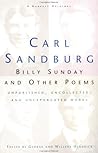
Review 741: Billy Sunday and Other Poems

Billy Sunday and Other PoemsBilly Sunday and Other Poems by Carl Sandburg
My rating: 4.25 of 5 stars


This book of poetry is organized into twelve parts. Nearly all of the included poems were previously unpublished. The title poem was one published before in 1916, but in a revised version and without naming the preacher. Most of the poems were written between 1910 to early 1930s.

The poems are generally easy to read, straightforward without a lot of abstraction. Sandburg wrote so the common person would be able to understand his meaning. And his meaning comes through clearly. He is one of the downtrodden, the working class, the poor. He is a socialist.

His words paint portraits of people. A few describe atrocities, such as WWI and the sinking of the steamship Eastland which resulted in the drowning of hundreds of people, workers and family on their way to a company picnic. There is a section of love poems as well, which are mostly tender or passionate.

I bought this book many years ago, before taking poetry classes in college. I do not remember what brought me to purchase this book of poetry, perhaps it was what just a random purchase of poetry as I did back then. And hard to say why I never picked it up until recently.
Thursday, September 17, 2026

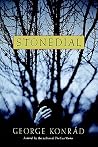
Review 740: Stonedial

StonedialStonedial by George Konrád
My rating: 3.5 of 5 stars


This book appears to be obscure, as there are only three other reviews and none in English. My English edition was published in 2000, which is before goodreads really became around, so perhaps that is why so few entries? I have discovered through goodreads this book is listed as a second in a series, although there is no indication of that in my book.

The book was a frustrating read, for at least the first half. I almost put it aside and DNF it multiple times but kept going since it’s not overly long and have owned the book for many years. In the end it was worth it to have kept going.

The book is a translation from a Hungarian, which might explain some of the awkwardness of the writing of the POV shifts, but I doubt it. There were history, future and present all going on at the same time, and with the POV shifts so it was fairly confusing. The main character, János Dragomán would be referred to in the third person, but sometimes in first person as the narrator. This shift would happen suddenly, and it took a while to figure out this was the same person being spoken about.

János Dragomán, an itinerant philosopher, professor and writer returns to Kandor to be awarded an honorary degree, and see his old friends. He is also a womanizer, which plays in the plot particularly in the later portion. The narration kept returning to 1956, when there was an attempt in Hungry to revolt against the Russian occupation. Dragomán was a student then and was active in this revolt.

In this present time Dragomán just discovers he has a daughter and grandson, which has him contemplating staying in Kandor. There is more, but I’d rather not reveal the entire plot.

A bit of a strange book, but glad I stuck with it. Most of the action was in the last quarter of the book, which was straightforward for the most part, unlike the prior portion of the book. I suppose this answers why there are so few reviews, I expect many would have given up as I nearly did.


Wednesday, September 16, 2026

Review 739: The Hemingses of Monticello


The Hemingses of Monticello: An American FamilyThe Hemingses of Monticello: An American Family by Annette Gordon-Reed
My rating: 5 of 5 stars


An incredibly detailed account of the Hemings family. Gordon-Reed places the Hemingses in the center of the narrative, how it was for them to live enslaved and without control over their life. Yet, with Thomas Jefferson some of the family had a greater degree of autonomy, they were treated better than the rest of his slaves. They were “privileged” within the slave community. Several generations of Hemings were from white masters and black slaves. Two of Jefferson’s offspring by Sally went on to live a life as a white person. All of their children were set free, eventually. It’s hard to imagine the mores of that time and place, that this was acceptable behavior.

Jefferson was careful in what was kept by his letters and writings. He tried to shape his historical image. Even at the time it was a scandal between himself and Sally, and still nothing was confirmed. Yet there are still facts, and of course now DNA evidence. He is quite the enigma.

Tuesday, September 15, 2026

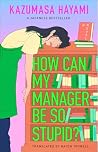
Review 738: How Can My Manager Be So Stupid?

How Can My Manager Be So Stupid?How Can My Manager Be So Stupid? by Kazumasa Hayami
My rating: 3.25 of 5 stars


Another fictional workplace book, this one about being a bookseller. Admittedly I was pulled in by the cover artwork.

The main character, Kyoko Tanihara works at Musashino Bookshop. She is frustrated with her job, the manager especially. She works in the literature department and is frustrated that publishers don’t send the books that she knows would sell. She orders the books, but they don’t arrive, or if they do only one or two copies, when they could sell many more. There are customers who complain that they want the hottest new book, but the store can’t get it. Although it’s the manager who Tanihara mainly complains about and how he runs things. His morning meetings he usually is glowing about a management book that everyone should read.

Through most of the book Tanihara is on the verge of quitting. She does have a lot of anger, but she is a book lover and is very involved in the dynamics of the job and even with an author or two. I was lukewarm through most of the book, but I liked how it ended up.


Thanks to Penguin Group Putnam/G.P. Putnam's Sons and NetGalley for an uncorrected electronic advance review copy of this book. However, I listened to a published audiobook copy of the book.

Saturday, September 12, 2026

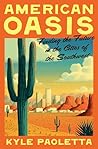
Review 737: American Oasis

American Oasis: Finding the Future in the Cities of the SouthwestAmerican Oasis: Finding the Future in the Cities of the Southwest by Kyle Paoletta
My rating: 2.75 of 5 stars


While the book was okay and I’m glad to have read it, I don’t think the premise of the book held up. The author profiled a few cities in the southwest looking mainly at: Phoenix, Las Vegas, El Paso and Albuquerque, with a few other cities being mentioned. All of these places are hot desert climates, having water issues and in the last several decades huge growth. Some history about these cities were discussed.

Yet, the author described many personal stories of individuals or families that seemingly had nothing to do with the topic, other than they live in that city. The opening described the author’s upbringing in New Mexico. While one story was about a man who lost his hands in 1946 as a boy while playing with explosives. Dealing with his disability ended up giving him some fame. First a newspaper article then later working in movies. Okay, but how does this relate to that particular city and the future? (not to mention this man had moved to another state.) There are many digressions and stories like this. Interesting characters, but not all that relevant.

The last part of the book seemed to regain focus and keep on topic. Water issues are a problem and will be more so in the future. Looking at these desert and drought-prone areas is a good idea for finding solutions for the future. One interesting piece of information was that despite all the growth in Las Vegas, through their water policies the amount of water consumed has stayed at the same level. I just wish the narrative had kept this at the forefront for most of the book.


Thanks to Knopf, Pantheon, Vintage, and Anchor/Pantheon and NetGalley for an uncorrected electronic advance review copy of this book. However, I read and listened to a published copy of the book, as it was published over a year before I finally got to the book. Apologies for the lateness.


Previous Popular Posts